
How AI Revolutionizes Dental Diagnosis
From detecting hidden cavities to predicting treatment outcomes—the transformation of modern dentistry through artificial intelligence
Artificial intelligence isn't just a buzzword in dentistry—it's actively changing how we diagnose problems, plan treatments, and predict outcomes. As someone who's taught at the Kois Center and stayed at the forefront of dental technology, I've witnessed firsthand how AI tools are enhancing diagnostic accuracy and improving patient outcomes.
The Diagnostic Challenge in Traditional Dentistry
Even with advanced training, human diagnosis has limitations. Subtle changes between X-rays taken years apart, early-stage decay beneath existing fillings, or hairline fractures in teeth can be missed by even the most experienced dentists. Not because of incompetence, but because of the limitations of human pattern recognition when reviewing hundreds of images per week.
"AI doesn't replace clinical judgment—it augments it. Think of it as having a second set of eyes that never gets fatigued and has analyzed millions of cases."
How AI Enhances Diagnosis
1. Cavity Detection
AI algorithms trained on millions of X-ray images can detect early-stage decay that might be difficult to see with the human eye. Studies show AI systems can identify cavities with 95% accuracy—often catching them earlier than traditional visual examination.
Real-world impact: Earlier detection means smaller cavities that require less invasive treatment—often just a small filling instead of a crown.
2. Bone Loss Assessment
Periodontal (gum) disease causes gradual bone loss around teeth. AI can measure changes in bone levels between X-rays taken months or years apart with millimeter precision, tracking disease progression or improvement after treatment.
Real-world impact: Objective measurements help us determine if gum treatment is working or if we need to adjust the approach—taking the guesswork out of periodontal management.
3. Treatment Outcome Prediction
Perhaps the most exciting application: AI can analyze your specific case and predict how likely different treatments are to succeed. For complex cases involving dental implants or full-mouth reconstruction, this is invaluable.
Real-world impact: We can have more informed discussions about treatment options, helping you make decisions based on data-driven predictions rather than generalizations.
Overjet AI: FDA-Approved Diagnostic Intelligence
At Prentice Dental, we use Overjet AI—an FDA-approved artificial intelligence system that analyzes X-rays with exceptional accuracy. This isn't experimental technology; it's proven software that augments our diagnostic capabilities in measurable ways.
What Overjet AI Does:
- Analyzes every X-ray instantlyscanning for cavities, bone loss, defective fillings, and calculus buildup with consistent accuracy
- Detects early-stage decaythat may be difficult to spot with the human eye, especially between teeth or beneath existing fillings
- Measures bone loss preciselytracking periodontal disease progression or improvement with millimeter-level accuracy
- Provides objective dataremoving subjectivity from diagnosis and creating a clear baseline for monitoring changes over time
The result? Earlier detection of problems when they're smaller and easier to treat, more accurate tracking of disease progression, and objective data that helps us make better treatment decisions together.
How Overjet AI Works in Practice
When we take your X-rays, Overjet AI analyzes them within seconds. The system has been trained on millions of dental images and can identify patterns that might take a human eye much longer to detect—or might be missed entirely on a busy day reviewing dozens of X-rays.
The Diagnostic Workflow:
- Digital X-rays are captured using low-radiation sensors
- Overjet AI analyzes the images, flagging areas of concern
- I review the AI findings alongside my clinical examination and your health history
- We discuss any findings together, looking at the AI-annotated images on the chairside screen
- Treatment decisions are made collaboratively based on the complete picture
This combination of AI precision and clinical judgment provides a level of diagnostic accuracy that neither could achieve alone. The AI never misses a detail due to fatigue, and I provide the context and treatment expertise that AI cannot.
The Digital Smile Design Revolution
For cosmetic cases, AI-powered digital smile design lets us show you your potential results before we start. The software analyzes facial proportions, tooth position, and even smile dynamics to create a preview of your new smile.
The Process:
- We take photos and scans of your current smile
- AI software analyzes your facial features and dental anatomy
- We collaborate with you to adjust the design until it matches your aesthetic goals
- The final design guides the actual treatment, ensuring precision
This removes much of the uncertainty from cosmetic dentistry. You're not hoping for a good result—you're approving it before we begin.
What AI Can't Do (Yet)
It's important to be realistic about AI's current limitations in dentistry:
- •AI can't perform the tactile examination—feeling for fractures, soft tissue abnormalities, or movement in teeth
- •It can't understand your personal goals, concerns, or values, which are crucial for treatment planning
- •AI provides recommendations, but clinical judgment is needed to interpret them in the context of your overall health and history
This is why I see AI as a powerful assistant, not a replacement. The combination of AI analysis and experienced clinical judgment provides better outcomes than either alone.
The Future: Predictive Dentistry
The next frontier is predictive care. Imagine AI that can analyze your X-ray history, genetics, home care patterns, and health data to predict your risk for specific problems—then recommend personalized prevention strategies.
We're moving from reactive dentistry (fixing problems after they occur) to truly preventive care (stopping problems before they start). AI is making this shift possible by identifying patterns and risk factors that would be impossible to spot manually.
Our Approach at Prentice Dental
We integrate AI tools throughout our diagnostic and treatment planning process, but always with the understanding that technology serves the patient, not the other way around. Every AI recommendation is reviewed, validated, and discussed with you before any treatment begins.
The goal isn't to have the most advanced technology—it's to provide the most accurate diagnoses and the best treatment outcomes. AI helps us do that more consistently than ever before.
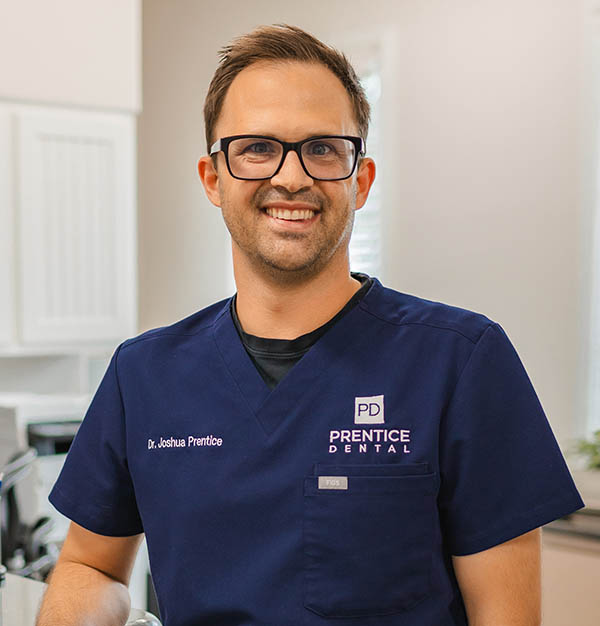
About Dr. Joshua Prentice
DDS, Kois Center Graduate with Honors
Dr. Prentice has completed advanced training at the prestigious Kois Center, one of dentistry's most respected institutions for comprehensive treatment planning and evidence-based care. He lectures nationally on complex restorative dentistry, digital workflows, and airway-centered treatment.
With over 15 years of experience in comprehensive dentistry, Dr. Prentice combines cutting-edge technology with evidence-based protocols to deliver predictable, lasting results for complex dental cases.